Just in Time For Halloween, New Poems and Stories at the TTB e-zine!
OK, sometimes I just have to rhyme…
Folks, do you want some new and absolutely free reading material? Especially from me? (As you’re here at my blog, I’m going to assume the answer is an enthusiastic “yes.”)
Well, look no further. I have a story, “To Exist within Memory,” and a poem, “Break the Dark Lens,” up at the Halloween 2017 edition of the Twilight Times e-zine. (I abbreviated it above as TTB e-zine because it’s part of Twilight Times Books.) In addition, there’s also a chapter reveal for my most recent novel, the LGBT-friendly CHANGING FACES, and there’s an author interview by Mayra Calvani as well — so if you have ever wanted to know more about me or my writing, here you go.

Mind, if you like what you have read with regards to CHANGING FACES, you can go to Amazon or Barnes and Noble and pick up an e-book copy for just ninety-nine cents…and I do hope you’ll consider doing just that.
So go check out the TTB e-zine. Read some free stuff. Then go pick up your copy of CHANGING FACES today, and get to getting…who said every treat on Halloween has to be full of calories, hey?
Now Available in E-Book: A LITTLE ELFY IN BIG TROUBLE
Folks, I’m very happy to be able to finally report that my second novel — and the second novel in the Elfy duology — A LITTLE ELFY IN BIG TROUBLE has been released. It’s available right now at Amazon and OmniLit…the latter will be most useful if you need an e-pub version of the file.
Edited to add: Barnes and Noble link is now live as well. Now returning you to your regularly scheduled post…
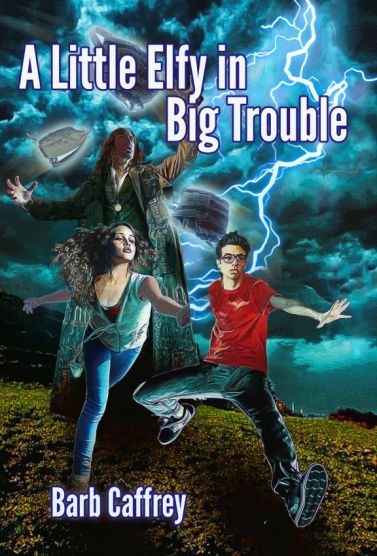 If you have never seen anything at all about the Elfyverse — or read book one in the Elfy duology, AN ELFY ON THE LOOSE — this little blurb may help you with what’s going on:
Young Bruno the Elfy and Sarah, his mostly-human teenage girlfriend, are in deep trouble. Bruno’s Elfy mentor Roberto the Wise is about to be sacrificed by a Dark Elf, and Sarah’s parents have decided to help the Elf rather than the Elfy. Things look bleak and are getting worse by the minute, but Bruno and Sarah have a number of allies — human, Elfy, and ghosts — that the Dark Elf can’t possibly expect. Can young love, desperation, and great unexpected power win out despite it all?
And here’s a short excerpt — note, it first appeared here, as part of the Marketing for Romance Writers Book Hooks blog hop:
Bruno took Sarah’s hand and led her back outside. He looked with his mage senses, and felt nothing; no Elfy magic, no Human magic, and as far as he could tell, no Elf magic, Dark or Bright.
He put up a light shield that should help conceal their voices, and decided it was safe enough to talk for a bit.
“Tomorrow is Ba’altinne, Sarah.” Bruno rubbed his fingers through his hair and tried not to look too hard at Sarah. Goddess, she was beautiful. But he had to stay on topic. “That’s your May Day. Tomorrow.” He shook his head and tried not to frown. “How can we get everything together in time to stop Dennis the Dark Elf?”
“I have faith in you,” she said. Her eyes darkened. Bruno felt as if he were falling, before she gently brushed her lips against his.
————————— End Excerpt ————————————-
If this has intrigued you (and of course I hope it has), but you aren’t sure you will like my book yet, I also have three sample chapters available at Twilight Times Books’ website — here’s the link for that: http://www.twilighttimesbooks.com/ElfyinBigTrouble_ch1.html
A LITTLE ELFY IN BIG TROUBLE continues to make me laugh. I’ve enjoyed writing about Bruno, Sarah, Reverend Samuel and his family, Lady Keisha, even Dennis the Dark Elf…and I hope to write more about them, ’cause I have a hunch their stories are not over.
At any rate, most of you know the labor of love that kept me working on Elfy for years. I’m ecstatic that both halves of my novel have now been published, and I hope you’ll enjoy reading them as much as I’ve enjoyed writing them.
Anyway, both novels are available now as e-books. So what are you waiting for? Go grab a copy — or copies — today! (And be sure to tell your friends. ‘Cause, really…how can you go wrong?)
Welcome to the Elfyverse…
Thank you for stopping by my blog, which is called either “Barb Caffrey’s Blog,” or “the Elfyverse.”
Why two names? Well, I figured it would be easier for people to find me if they used my name. But I’ve been writing about Elfys, Elfs, Dwarves, and more for over ten years — thus “the Elfyverse.”
As for what I do here, it’s simple: I talk about anything I like.
I’ve been blogging now for over five years. (Here’s a link to my first blog post, if you don’t believe me.) Over that time, I’ve talked writing, publishing, music, sports, current events, politics . . . anything that I feel like talking about.
So while you’re here, expect the unexpected . . . because you never quite know what I’m about to say.
Please feel free to stop by any time you like. And tell your friends about all my work, including AN ELFY ON THE LOOSE (Barnes and Noble link is here) and the first two stories of my late husband Michael’s, “A Dark and Stormy Night” and “On Westmount Station,” all available at Amazon.
And remember . . . support a real writer.
My novel, “An Elfy on the Loose,” Is Now Available
It’s been a long time in coming, but my first novel, AN ELFY ON THE LOOSE (now with a subtitle of “Book One of the ELFY duology”) is now available at Amazon.com and will be available soon at all major e-book retailers.
**Edited to add: AN ELFY ON THE LOOSE has also “gone live” at BN.com (Barnes and Noble’s website), as Paul Howard told me in the comments. If you have a Nook and want to read AN ELFY ON THE LOOSE, now’s your chance!
Now back to our regularly scheduled post.**

I’m very pleased that AN ELFY ON THE LOOSE is now out, even though I hadn’t expected it to “go live” on Amazon tonight, of all nights — but as it has, I figured I’d best skedaddle and get a blog post up, pronto.
For those of you who want a sample, please go here and read the first five chapters of AN ELFY ON THE LOOSE . . . then, I hope you’ll go to Amazon and get the e-book, as it’s on sale for a limited time at the low price of $3.99.
Because I’m a new author, and because I’m decidedly not well known, it is anyone’s guess as to whether or not AN ELFY ON THE LOOSE will do well enough to warrant an actual “dead tree” edition (that is, a paper edition).
For all I know, this e-book copy is all that we’re likely to get. So I hope you’ll enjoy it in the spirit intended.
In other words, if you want to read my novel because you’ve been intrigued about Bruno the Elfy and Sarah his human companion and want to know all about Sarah’s house (which is an Elfy trap of major proportions), or if you want to figure out why a Dark Elf would go to Northern California, or if you even want to know why Bruno’s mentor Roberto is worth saving despite being more than a bit of an butthead sometimes, now’s your chance.
I also hope that if you read and enjoy AN ELFY ON THE LOOSE, you won’t be averse to letting people know my book exists. Because I need all the help I can get . . . and I’m not shy about saying so.
My Discussion Regarding the Milwaukee Bucks and Their Series Loss to the Indiana Pacers
Folks, I have neglected my blog lately. I am sorry about that. I’ve been running out of hours in the day, and writing, whether it’s blogging or some fiction or whatever else, is taking a big backseat to Life (TM) these days. But as I am a fan of the Milwaukee Bucks, and as they were in the playoffs, I made sure to either listen or watch every single game this past week. (Considering I try to listen or watch every game during the regular season as well, that’s not too surprising.) And I have some thoughts.
Here we go.
I was fortunate enough to watch the Bucks play the Pacers in their last two playoff games (I listened to the others). I was seriously impressed by how hard the Bucks played despite their overall series loss to the Pacers (more on this in a bit). They were brilliant in Milwaukee in Game Five, which they needed to be in order to force Game Six in Indiana. One of their two big stars, Damian Lillard, played in Game Six after having to sit out the two previous playoff games, and did rather well, especially considering he was dealing with a strained Achilles tendon. He led all scorers, in fact…but despite good defense from nearly every Bucks player (including Lillard, and his forte is definitely not defense), the Bucks ran out of gas. They lost, 120-98, and the Pacers now advance to the next round.
Mind you, the game was not quite as lopsided as the score says. The Bucks coach, Doc Rivers, took most of his players — the starters, the main bench people, etc. — out of the game starting at around the four-minute mark. I believe the Bucks were down by sixteen at that point, and while that’s potentially doable if someone like Lillard hit a bunch of three-point shots and the extremely tired and gassed defense was able to get four or five stops in a row, it would’ve been a very long shot. I think Rivers did the right thing in pulling out guys like Lillard, Bobby Portis, Khris Middleton (who had a brilliant series of his own, especially in Games Four and Five), Patrick Beverley (aka “PatBev”), and Brook Lopez. Those guys should all hold their heads up, as they did the best they could all the way around.
Why do I say this? Because the biggest star on the Bucks, Giannis Antetokounmpo, was not able to play at all. He averaged something like forty points a game against Indiana, even though the Bucks as a whole had not done all that well against them. So, if you count him, and you see all these other players doing what they just did in stepping their games way up (or in Middleton’s case, reminding everyone why he was an All-Star a few years ago), I think at minimum the Bucks would’ve forced Game Seven in Milwaukee. At maximum, they would’ve won.
One stat for Game Five tells pretty much the whole story. There had never before been a playoff team, without its top two scorers (in the Bucks case, those were Lillard and Giannis), that had actually won a playoff game before. But the 2023-4 Bucks did just that. Middleton and Bobby Portis (a Sixth Man of the Year candidate; he finished third for the second year in a row) both scored twenty-nine points, and had twelve and ten rebounds, respectively. In addition, PatBev played the point position and passed the ball around — something he usually is not called upon to do — and scored thirteen points with twelve assists. Center Brook Lopez also scored twelve points. The Bucks played outstanding defense, held the Pacers to just 92 points in Game Five, and beat them 115-92.
In other words, without Giannis and Lillard, they were more like the “little team that could” (except for how tall they are, of course). They believed in themselves, and it showed. It was good that they got one more win at home and got to hear the love from the Milwaukee fans, because they really did pour it all out onto the floor.
So, the Bucks should hold their heads high despite losing the series to the Pacers. They did their best. Lillard came back in Game Six, and, while obviously not healthy, scored twenty-eight points and played far better defense than I’d expected. Portis had twenty points and fifteen rebounds. (The Indiana crowd hates Portis, so this was I hope some small amount of solace for Portis going into the offseason.) Lopez played one of his best games of the year, scoring twenty points and pulling down five rebounds. PatBev, while obviously tired and injured — he’d been playing despite an oblique injury for the past several weeks — again pulled down five assists and scored six points. (Remember, he’s not usually called upon to do either one. He was used primarily as a defensive “energy” guy, which makes sense: Beverley has been a member of the NBA All-Defensive Team three separate times.)
I was — am — happy with my favorite team. I wanted them to win Game Six just as much as they did…well, maybe not quite as much, but certainly I wanted them to win.
They didn’t win, no. But they did their level best. I can’t get angry with any of them.
For other sad Bucks fans out there: You need to remember that in any playoff scenario, a good team is going to go home in round one. Maybe several good teams will go home in round one. It doesn’t matter if it’s the NCAA Basketball Tourney, or the major league baseball playoffs, or the wildcard games in football…a good team or two always ends up going home sooner than expected. Oftentimes, it’s because key players were injured and/or were not able to play up to full capacity.
And we both know who wasn’t able to play at all, while several others couldn’t play up to their full capacity (but did their best and came darned close to it).
What I saw from my favorite team, the Bucks, was perseverance, grit, teamwork, and a never-say-die attitude. I hope most of the players will be back next year (I think it’s a lock that Lillard and Giannis aren’t going anywhere, and I’d be stunned if Middleton went anywhere either), as I think if folks like PatBev (a midseason acquisition) had played with everyone all year long, it’s possible this team would’ve forced Game Seven even without Giannis (a former two-time MVP of the NBA, a past multiple winner of the all-defensive team, and, like Lillard, a member of the all-NBA 75th anniversary team).
What I will take away from this loss is this: You can hold head up high when you do your level best. You may not win all the time. You may not be able to meet your own goals (PatBev said right away he wanted to win the NBA Championship just as soon as the Bucks traded for him; he also had some negative history with Damian Lillard, and said he had to “get right with Dame”). But you will still impress people if you give it your best shot, and most especially if you go outside of your comfort zone and do things completely unexpected of you. (That would hold true for the vast majority of the 2023-4 Milwaukee Bucks.)
How Do We Go On?
Some days are better than others. Some nights, too.
Last night, I had one of the worst nights in recent memory. It seemed like everything was in an uproar — my physical pain was high, my grief level for my father (and, of course, for my husband) was very high, and I was yet again at the same point I often am: Is this all there is? Is there nothing more?
Not to mention the biggest question I ponder daily: Am I doing any good in this world at all?
I believe the unexamined life is not worth living. But my quest to find meaning and purpose in what I do, lately, has been ground down by life circumstances beyond my control. If I had the financial wherewithal, I might consider a vacation…just to get away, to clear my head, to give myself some chance to rest and recover.
But I don’t have the means.
So, I’m trying to give myself a break in other ways. I don’t know yet if what I’m doing is viable, even in the short term. But listening to more music, reading more for pleasure (even if it’s just a frothy romance, if it makes me smile or laugh, it’s worth whatever price I’ve had to pay to get it), and doing what I can to help others (or at least not to hinder them) has to at some point make a difference even if I can’t see it.
I was reminded a few days ago of something that happened when I was in my teens. I was in religious education — CCD class, as I was raised Catholic — and I was a bit older than most of the other students as I wanted to ponder for a few years whether or not to get officially confirmed in the religion. (This was a big deal at the time.) My parents were not happy together, and were on the road to divorce; worse, I felt like I never fit in, and my skills in music, writing, and teaching did not seem like they would ever lead me in a prosperous direction. (I guess prosperous is a matter of opinion.) I often felt like giving up, yet I couldn’t do that. I wouldn’t. But as the chaos around me continued to grow, my personal belief in myself faltered.
Then we had an exercise in CCD class. We had to pick names out of a hat, keep them secret, and write something positive to them for a few days to a few weeks. We could do anything we liked, so long as it was positive.
I can’t remember what I wrote to my correspondent that I’d picked out of a hat. I do remember what the young woman wrote to me, who’d picked my name out of a hat. She sent me pictures of rainbows, poems (not romantic ones, though I wouldn’t have known the difference back then!), and quotes of stuff I’d said when trying to be encouraging that had inspired her. I had no idea that anyone saw me that way, especially as I didn’t see myself that way whatsoever.
When the day came where our correspondent had to come up and introduce themselves, I still remember the young woman coming to me. She was fifteen, I think; I was seventeen. I’m going to call her “Alice,” here…anyway, Alice came up to me, and said she’d always appreciated me. She knew my situation was difficult. (I don’t know how, because while I did discuss some things, I was still deep in the “I don’t know what to say or how to say it” phase of adolescence; sometimes I wonder if I ever got out of that phase, in fact, but I digress.) She wanted me to know that at least one person saw me not only as worthy, but as inspirational…and she reminded me that God (as Catholics believe in a male deity, though some priests including writer and priest Andrew M. Greeley, believe in the Holy Spirit as Sophia, Goddess of Wisdom) loved us all.
I have never forgotten what she said, what she did, or the various ways in which she did it. I also remember how floored I was that she saw me that way.
So, when I think about having a rough night, or two, or twenty, I do my best to remember Alice and what she told me.
I do believe the spirit is eternal, I do believe the Goddess loves us all, and I also believe that we’re here for a reason even if we don’t know what that reason is.
I’ve struggled a lot in recent years with many things. But I’m not yet willing to give up on myself or my talents, no matter how difficult it may seem to use them.
Please wish me well as I continue on this quest to find a meaning, a purpose, a goal, or a decision that matters…not just to me, but to those I care about as well.
Easter Blessings…
Folks, it’s Easter. I usually try to write something, anything about the huge observance of Jesus Christ’s resurrection and assumption into Heaven as it’s one of the most interesting stories ever told.
I mean, really. Think about it. The Deity sent Jesus, the Deity’s child, to save the world. Jesus’s path was not easy. He was betrayed by one of his best friends and apostles, Judas. His death was treated as a type of spectator sport, and he died in agony. He really didn’t know why the Deity had seemingly forsaken him, and he had no idea of what his destiny truly was.
Why was this? I think it’s because life ground Jesus down somewhat. Jesus came into this world knowing he was special. His parents traveled to save his life, and his titular father, Joseph, was not Jesus’s actual father. Mary, Jesus’s mother, had been impregnated by the Deity, and was still virginal; she married Joseph, who by accounts was a kindly older man, to have some protection and some status while she carried the son of God/Deity.
So, you are told your whole life that you’re special. There were Wise Men who blessed your birth and gave your parents unusual and very expensive gifts. (Think about how difficult it was to get or pay for stuff like frankincense and myrrh back then. I don’t think it was something that just grew and could be harvested anywhere.) Your parents had more children, yet Joseph knew you were no part of him genetically…he was more like a foster Dad, or a Stepdad, and all of Joseph and Mary’s other children were Jesus’s half-sibs. Then he was trained by various scholars and legalists, something his half-sibs did not get and probably did not want. His rise was seen as almost assured.
Then, Jesus took up carpentry. This probably wasn’t what anyone had expected of him. He was not a rabbi at that point. He was instead a hard-working man, but at most he was probably lower-middle class as we see it today. He worked hard, he probably drank with his buddies, he may well have looked at women (he always liked women and did not look down on anyone who did what she did to survive, including prostitutes), and lived as close to a normal life as was possible.
Then Jesus was reminded of his special nature, and started to walk among people as a prophet of sorts. He gathered allies, many of whom were men; they gave up all their worldly possessions to follow him and help others.
Think about this for a moment. Our analogue for this would be something like hippies. Well-meaning, granola-crunching hippies. They wanted to feed the hungry, clothe the naked, treat the sick and comfort the elderly. Rabbis already did some of these things, but they weren’t doing enough and Jesus and his followers knew it.
Consider that, the next time you wonder why people didn’t listen to Jesus from the first.
Following what Jesus taught is not easy. Writer G.K. Chesterton once said something along the lines of “Christianity is the best religion that’s never been tried,” and there’s a lot of truth in that. Most of us are going to fall short in our observance of helping to feed the hungry, clothe the naked, treat the sick and comfort the elderly. The modern world — no matter what age we’re in — makes it tougher to have deep and meaningful relationships with people, and without such relationships, we as human beings tend to founder.
Anyway, it is Easter. If you are alive to read this, you are blessed.
If you want to help someone today, I think Jesus would like that. I also think that if it’s possible, you should pray for the Palestinians starving in Gaza, pray for the Ukrainians as they continue to fight a huge war against Mother Russia and Vladimir Putin, and do what you can to help those in your communities live better, healthier, and happier lives.
At bare minimum, though, remember this: Jesus said to love one another as he loved us.
This world needs a lot more of such selfless love, so try to give some today.
This Just In: Studebaker’s Gas Station Is a Wonderful Place…
Folks, in July of 2022, I wrote a blog called “A Requiem for Willkomm’s Mobil” about how my favorite place in Racine County, the Willkomm’s drive-thru gas station on Washington Avenue in Racine had closed. I was very frustrated, because I’d written to the owner and told him exactly what I thought: that the Willkomm’s had friendly people who remembered what I ordered and would go the extra mile, and who never treated me — a disabled woman — as anything other than a good human being.
Well, I have news.
In late January of this year — 2024 — I found out that Studebaker’s Mobil was coming to North Green Bay Road in Racine. This turned out to be true, and it’s been open since that time. The actual address is 1215 North Green Bay Road, Racine, WI, 53406. Studebaker’s is run by the same people who ran my favorite Willkomm’s, and it also features a drive-thru where it’s possible to get anything you’d normally find in a gas station through that same drive-thru.
I vowed to patronize it just as soon as I could. This wasn’t easy, as at the time there were some members of my family who were not feeling well. I was doing what I could to help in that regard, even though most of what I could do were small things…nevertheless, once they got better, I did indeed go to Studebaker’s.
I loved it.
The same people work there who worked at the Willkomm’s, along with a few new people I don’t know. They’re all friendly, knowledgeable (one of the clerks, Nick, remembered that I always liked a large diet Pepsi fountain drink, and brought me one right away the first time it was available; yes, I paid for it, but I didn’t ask for it), and very good people. There’s a large variety of soft drinks, liquor of most sorts (including some craft beer selections; I got one called “Dragon Milk” for my good friend Lika and her family as a late birthday present, and she said she enjoyed it), various types of foodstuffs like milk, bread, Snickers bars (I do love those, probably more than I should!), and much more.
I enjoy Studebaker’s gas station very much. (If they had a website up, I’d link to it, but they don’t as of yet.) As I said, they are extremely good people, friendly, knowledgeable, will remember you and will do their utmost to serve and help you in whatever ways they possibly can.
I’m very glad to let the readers of my blog know about Studebaker’s, even though I know most of my long-term readers don’t live in Wisconsin at all, much less Racine. But if you do ever come here, I hope that Studebaker’s will still be open so you can get a taste of what Wisconsin hospitality is all about.
Edited to add: Studebaker’s, like my old favorite Wilkomm store that closed in June of 2022, is the only drive-thru of its type in all of Racine County. It is an especially fine place to go if you are disabled because you do not have to get out of the car. (They will even pump your gas for you. How cool is that?)
A 12-Year Widower Discusses His Life and Grief
I thought this blog was well-written, timely, and might be of interest to at least some of my readers and friends. (Often one and the same, but I digress.)
His path is not the same as my path, but I honor what he’s done and what he continues to do. He has found love again, bless him…but that does not at all mean he’s forgotten his late wife, and it does not at all mean that he’s happy-happy joy-joy all the time.
This is a lengthy blog, but a worthy one. I really hope at least some of you will consider reading it all the way to the end.
Sunday Reflection
In the past few weeks, I was reminded — forcibly — that life is incredibly short.
There is a Biblical quote that comes to mind about such times. It’s from Psalm 90, verse 12. “So teach us to number our days, that we may apply our hearts unto wisdom.”
It seems to me that too many people in this world forget both parts of that equation. Time is very short, so we have to work hard to find wisdom as our days are numbered and we have no idea when the end will come.
I try to find wisdom, teachings, and purpose wherever I can, partly because I know how short time is. (Ask anyone widowed young, and they’ll agree with me.) The other part is, I’ve always tried to find common ground with other people whenever possible, in the hopes that light can shine not only in my life, but in someone else’s life, too.
There are many things I’d do differently, if I had more energy, health, financial security, and overall stability. But seeking out purpose and wisdom would not be one of them.
As the ancient proverb says, “Time and tide wait for no man.” Please remember that, and don’t put off until tomorrow what you could do today to make someone’s life a little better.
Discussing Daughtry’s SFnal, Dystopian Single, “Artificial”
The other day, I heard a new song from Daughtry, the band fronted by former American Idol contestant Chris Daughtry. Daughtry is known mostly for their single “It’s Not Over.” That’s a hopeful song, in its way, about the ups and downs of relationships. But the new song, “Artificial,” definitely is not hopeful. In any way.
“Artificial” is about human beings being supplanted by robots, AIs, synthetics…the world has turned poisonous, and the scenery looks like an old Mad Max movie, which sets the scene for the dystopic lyrics. For example, the second verse includes the lyrics, “No sickness, no dying, no disease/no begging for mercy on your knees. No God, no religion, no beliefs.” This may seem somewhat innocuous, especially to secular humanists, but the choruses definitely aren’t. “Welcome to your worst nightmare. Days are getting dark, you should be scared. It doesn’t have a heart. Plug into the new you…the death of who we are is right here.” (I jumped a few lines down, thus the ellipsis.)
Because Daughtry himself is muscular and fit–especially for age 44–he plays himself being uploaded into the “perfect,” human-looking robot. Fortunately, or maybe unfortunately, it doesn’t exactly work out.
Now, why did I say fortunately, or maybe unfortunately? Well, in this dystopic nightmare of a world, that’s apparently the only way you’re going to survive. It’s a travesty; it’s not human, as the lyrics say. The whole bit about “no begging for mercy on your knees” is about compassion, and about how the robots–or whatever they are–don’t have any. They’re just beings, without true emotions; they think, but they don’t sleep. They can’t admit to fear, even if they feel it–then again, they don’t feel much of anything–and it’s obviously not the way a human being wants to live.
There is a second level to “Artificial,” though, that’s more relevant to me as a writer and editor. There’s a real problem right now, that’s grown significantly worse in the past five years, with AI programs grabbing hold of people’s work–whether music, art, writing, you name it–and not paying anything for this. If one, single AI was the creation of some guy in his basement who had no money at all, then maybe this wholesale “borrowing” (read: using without paying) would be understandable even if still wrong. However, the AI programs are being developed by some of the biggest and wealthiest companies in the world.
They don’t have an excuse. They should be paying writers, musicians, artists, etc., for the use of their works if they’re going to be used to try to bring about a better and more comprehensive version of AI (artificial intelligence).
So, the lyric “It doesn’t have a heart” in “Artificial” could, conceivably, be talking about Google. Or Microsoft. Or whomever else that’s trying to develop an AI. If they had hearts, working souls, and even an ounce of compassion, they’d not have taken so many different people’s work without paying for it.
They certainly don’t seem to have ethics, either. Or they’d be paying writers, musicians, etc., for their work. As they should.
So, getting back to “Artificial,” Daughtry seems to be saying that in the not-so-distant future, there will be copies of what he does. Purporting to be what he and his band have actually done. (Maybe he’s referring to deep-fakes, in an elliptical way.) But it’s “ice cold, mechanical. Artificial.”
A real musician, a real band, playing in real time (even if it’s recorded and played back in any medium), has a nuance and resonance that, so far anyway, synthetic programs can’t match. The sound, itself, may seem to be easily replicated, but it’s not.
You might be asking, “Barb, what are you talking about? The YouTube video will always play the same version of the song, with no variations.”
But in live performance, there will be variations. There have to be. Every time a piece of music is played, sung, or performed in any way, it’s going to be a little different in one way or another. That’s because it has life. Purpose. A sort of drive that infuses the music, makes it far more than simply numbers on a page represented as notes (and put to lyrics, in the case of Daughtry’s “Artificial”).
In short, music has soul. The best music, made by thoughtful musicians throughout our recorded history, has touched something in us, something profound. (Even something as silly as “Purple People-Eater,” with the lyrics of “one-eyed, one-horned flying purple people eater,” will make us laugh. Laughter, itself, can be profound in its way. So sayeth I, at any rate.)
Chris Daughtry and the rest of his band, Daughtry, are excellent musicians. They put together songs that tell stories. They have multiple levels in at least some of their songs (as seen with the recent song “Artificial”), which shows a remarkably fluent and in-depth understanding of what they’re trying to do. There’s life to their songs. And just a bit of edginess (which I appreciate), along with outstanding performance values, brings about the best of results.
So, “Artificial” is a departure for Daughtry due to being dystopic. But it’s a welcome one, especially under the circumstances. I hope they write a whole lot more songs about whatever they feel like, as there’s no way an AI could ever reproduce their passion, drive, wit, and ability.
Do not accept substitutes, people. (Further the writer sayeth not.)
 Barb Caffrey's Blog